
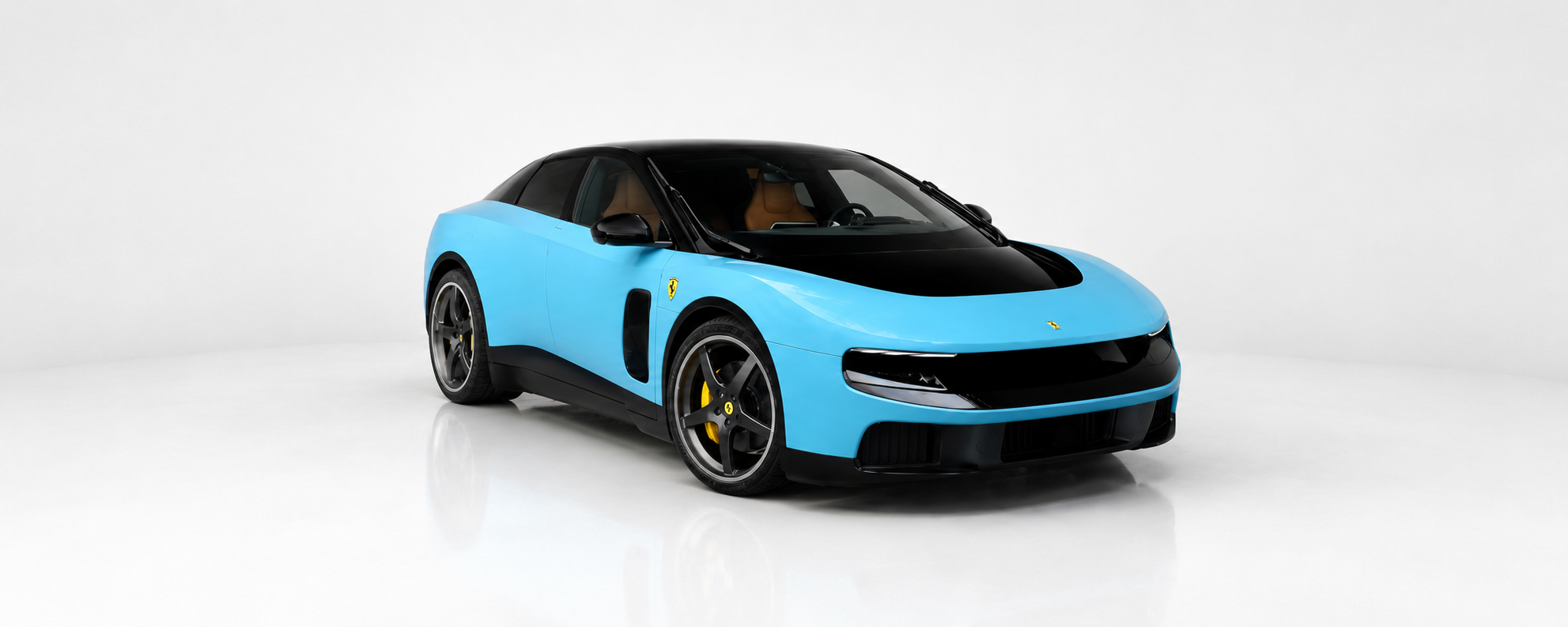
Is the Ferrari Luce a break with the Ferrari myth — or an attempt to carry that myth forward under new technical and social conditions? The quick judgements fall short. Good design does not merely confirm expectations. It also tests whether those expectations still hold.
When Ferrari recently unveiled its first fully electric production car, mockery, rejection and reflexive judgements soon followed. This is a familiar pattern. When something breaks away from a familiar formal language, it is initially measured not by its own logic, but by the viewer’s memory.
With electric mobility, the foundations of the brand are changing. The sensory brutality of the combustion engine disappears: sound, vibration, heat, mechanical immediacy. At the same time, social ideas of luxury, status, technology and responsibility are changing. Ferrari must therefore do more than simply preserve its identity. The brand has to translate it.
The decisive question is: which Ferrari values are still viable?
Racing heritage, risk, acoustic presence and radical irrationality cannot simply be copied by an electric Ferrari. It has to find new equivalents: tension, materiality, operation, acceleration, ritual, light and object quality. In this sense, the Luce does not appear to be trying to imitate Ferrari, but to transfer Ferrari into another medium.
The interior is particularly strong. It relies on a haptic, instrumental quality — with an extremely refined level of detail. It tries to make the digital physical again.
The exterior is more difficult. The Luce does not display the familiar Ferrari drama of visible engine staging and mechanical tension. It feels more closed, smoother, more aerodynamic, almost object-like. Less predator, more artefact. But here, too, there is refinement: in the handling of volumes, shut lines, highlights and the technical closedness of the surface.
One can also read this critically, because a car is not an object on a table. It stands on the road, has direction, mass, contact with infrastructure and social visibility. It does not exist only in the close range of the hand, but in public space — and it is potentially dangerous.
The design background of the designers involved, Jony Ive and Marc Newson, lies strongly in the world of the precise, closed, controlled object. It would be a mistake to treat Ferrari as though it were simply another premium product.
If the designers stated that they did not want to be retro and were confident enough to work independently of Ferrari heritage, I would regard that attitude as at least problematic. No product exists outside its cultural coding. Least of all a Ferrari.
Heritage should not be ignored; it must be transformed. Those who merely copy the past produce nostalgia. Those who ignore the past lose meaning. Good design recognises cultural codes, separates living values from dead forms, and translates them into a new present. Whether the Luce succeeds in doing this would be a fascinating discussion.
One mistake in many quick judgements lies in confusing the target group. The Luce is an extremely expensive electric high-performance object for a small, international, wealthy clientele: tech wealth, collectors, design and art milieus, new luxury markets, post-fossil status cultures — less so the traditional enthusiasts. For these people, a Ferrari involving Ive and Newson is not necessarily a betrayal. It may be precisely the attraction.
The reaction to Jaguar’s radical relaunch was also intense. Jaguar had, however, suffered from a severe relevance problem for years. The beautiful old brand romance was still culturally legible, but commercially no longer sustainable. A radical break, then, is not automatically madness. It can be an attempt to regain cultural visibility in the first place.
Brands do not survive by endlessly replaying their past. They have to reformulate their meaning under new conditions.
Perhaps the Luce is not a beautiful Ferrari in the old sense — and perhaps that is precisely its task.
Those who judge the new only by old standards are not measuring quality. They are measuring deviation. The question is not whether the Luce fulfils old expectations, but whether it creates new meaning.
Good design is strategic. It does not manage memory. It organises the future.